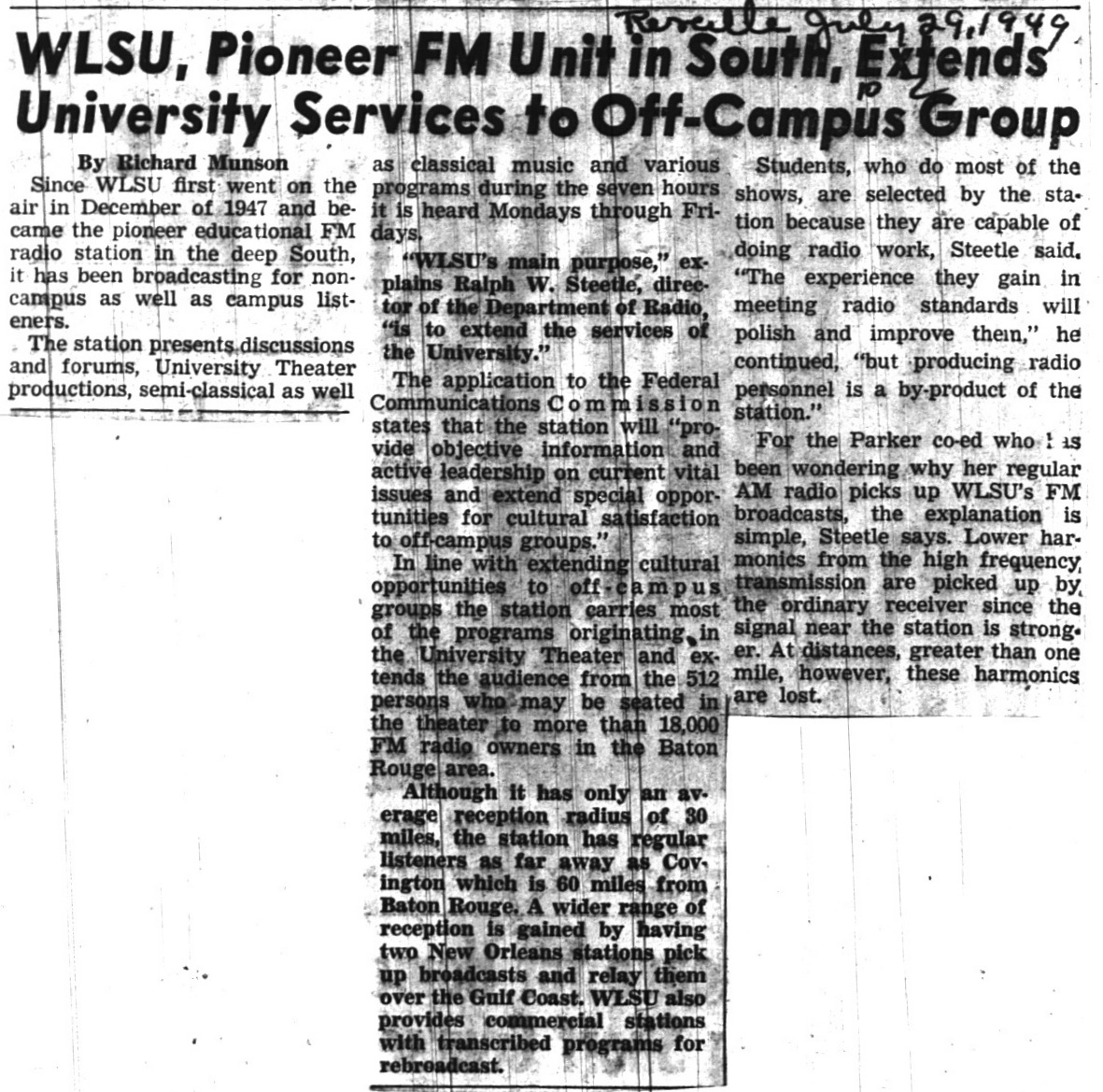
December 1947
WLSU begins broadcasting with 400-foot antenna and is on air for seven hours a day.
Lucile Ruby Woodard, former LSU Professor Emeritus of Speech and WLSU Program Director
details WLSU programming and the educational nature of the radio station. Lucile Ruby
Woodard Oral History Interview, Mss. 4700.0826, LLMVC, LSU Libraries.
View Transcript
JACK FISER: Where was your station physically on the campus?
LUCILE WOODARD: In a small building right across from the Sigma Chi house. It was a
cornfield when we . . . an experimental cornfield. And we had to wait until the
Agriculture Department to finish their experiment with the corn before we could
build . . . [laughs] start the building. But there were some cracks made about
that--where the station was being built. That it was appropriate to build it in a
cornfield. I don't . . . I think we lived up to a better reputation than
that.
FISER: Tell me exactly what the main part of the programming consisted of on that
station.
WOODARD: We had a varied program, but the greatest emphasis was on good music. All
kinds of good . . . no . . . we didn't have any country music. Most of our program
was music. But we did have other programming sources. We were a part of an
educational radio network at that time that shipped discs, these fifteen-inch
platters, from one station to another in sort of a round-robin fashion. That was our
network. After a while, a telephone wire network was established. But that was our
beginning.
Then we developed a School of the Air in cooperation with East Baton Rouge Parish
Schools where a number of subjects were taught. We started with music and then went
into . . . we found sources of recordings . . . recorded programs in other fields.
Western Electric, for example, put out a series of excellent science programs and
sources like that. We had school programs. Then we developed various programs of our
own. But during, I would say about a third of the day . . . weekdays, we'd broadcast
to the schools of East Baton Rouge Parish. Of course that, too, was a problem
because not many of them had FM radios.
There was an FM presence in Baton Rouge when we started. WJBO had established an FM
station in addition to their AM. And it was a good music station for part of the day
so that people sort of knew that there was such a thing. But a great deal of my time
was spent visiting schools and PTA meetings and so on, telling them of the
advantages of FM radio.
FISER: Now what exactly was the sponsorship of and the financing of all this? Was it
strictly an LSU affair?
WOODARD: That's right. That's right.
FISER: There was no state involved.
WOODARD: No, no. No, the state was not involved other than through the LSU
appropriation.
FISER: Certainly not the Fed?
WOODARD: No, no. It was purely an LSU project. Of course we had . . . It served an
educational purpose on campus, too. Because our announcing staff . . . All of the
announcers on the station were students who got the positions by auditions. All of
our assistant engineers were students. Our chief engineer was not. But we started
with a very small paid staff. Most of it was student work, but they were held to
professional standards. All of the announcers who worked for us in our first year or
two . . . first five years I would say . . . Particularly, I kept track of the ones
that worked for us for the first two years. They all went into jobs at radio
stations.
FISER: I remember some of them. I remember one young man particularly by the name of
Chuck Phillips.
WOODARD: Yes.
FISER: He was also from Iowa.
WOODARD: Yes, right.
FISER: He was here as a veteran.
WOODARD: [agrees]
FISER: And I later knew him as a regular radio staffer up in [?]. There was a young
man by the name of Campbell . . .
WOODARD: Yes.
FISER: . . . who became a fine major league play-by-play man for the Chicago White
Sox.
WOODARD: Yes, yes. Of course didn't broadcast any sports, so they didn't get their
background or training in that area. But they learned to be at home with the
microphone. They started out announcing programs of recorded classical music, most
of them. It was a good training for them, because we had some good listeners who
were helpful, in that if one of those announcers would mispronounce the name of a
composer or a musical selection, the telephone rang. When the program was over, the
telephone would ring and these helpful listeners would say, "I want to talk to the
announcer. Did you realize that you mispronounced that composer's name?" They got an
education. It served two purposes. I could have told them the same thing, and it
wouldn't have had the effect. One thing, they knew that somebody had caught them in
an error. But the most important thing was they knew they had a listener who cared
and who was following them and was a fan of theirs. It was great education.
Lucile Ruby Woodard, former LSU Professor Emeritus of Speech and WLSU Program Director details WLSU programming and the educational nature of the radio station. Lucile Ruby Woodard Oral History Interview, Mss. 4700.0826, LLMVC, LSU Libraries.
View Transcript
JACK FISER: Where was your station physically on the campus?
LUCILE WOODARD: In a small building right across from the Sigma Chi house. It was a
cornfield when we . . . an experimental cornfield. And we had to wait until the
Agriculture Department to finish their experiment with the corn before we could
build . . . [laughs] start the building. But there were some cracks made about
that--where the station was being built. That it was appropriate to build it in a
cornfield. I don't . . . I think we lived up to a better reputation than
that.
FISER: Tell me exactly what the main part of the programming consisted of on that
station.
WOODARD: We had a varied program, but the greatest emphasis was on good music. All
kinds of good . . . no . . . we didn't have any country music. Most of our program
was music. But we did have other programming sources. We were a part of an
educational radio network at that time that shipped discs, these fifteen-inch
platters, from one station to another in sort of a round-robin fashion. That was our
network. After a while, a telephone wire network was established. But that was our
beginning.
Then we developed a School of the Air in cooperation with East Baton Rouge Parish
Schools where a number of subjects were taught. We started with music and then went
into . . . we found sources of recordings . . . recorded programs in other fields.
Western Electric, for example, put out a series of excellent science programs and
sources like that. We had school programs. Then we developed various programs of our
own. But during, I would say about a third of the day . . . weekdays, we'd broadcast
to the schools of East Baton Rouge Parish. Of course that, too, was a problem
because not many of them had FM radios.
There was an FM presence in Baton Rouge when we started. WJBO had established an FM
station in addition to their AM. And it was a good music station for part of the day
so that people sort of knew that there was such a thing. But a great deal of my time
was spent visiting schools and PTA meetings and so on, telling them of the
advantages of FM radio.
FISER: Now what exactly was the sponsorship of and the financing of all this? Was it
strictly an LSU affair?
WOODARD: That's right. That's right.
FISER: There was no state involved.
WOODARD: No, no. No, the state was not involved other than through the LSU
appropriation.
FISER: Certainly not the Fed?
WOODARD: No, no. It was purely an LSU project. Of course we had . . . It served an
educational purpose on campus, too. Because our announcing staff . . . All of the
announcers on the station were students who got the positions by auditions. All of
our assistant engineers were students. Our chief engineer was not. But we started
with a very small paid staff. Most of it was student work, but they were held to
professional standards. All of the announcers who worked for us in our first year or
two . . . first five years I would say . . . Particularly, I kept track of the ones
that worked for us for the first two years. They all went into jobs at radio
stations.
FISER: I remember some of them. I remember one young man particularly by the name of
Chuck Phillips.
WOODARD: Yes.
FISER: He was also from Iowa.
WOODARD: Yes, right.
FISER: He was here as a veteran.
WOODARD: [agrees]
FISER: And I later knew him as a regular radio staffer up in [?]. There was a young
man by the name of Campbell . . .
WOODARD: Yes.
FISER: . . . who became a fine major league play-by-play man for the Chicago White
Sox.
WOODARD: Yes, yes. Of course didn't broadcast any sports, so they didn't get their
background or training in that area. But they learned to be at home with the
microphone. They started out announcing programs of recorded classical music, most
of them. It was a good training for them, because we had some good listeners who
were helpful, in that if one of those announcers would mispronounce the name of a
composer or a musical selection, the telephone rang. When the program was over, the
telephone would ring and these helpful listeners would say, "I want to talk to the
announcer. Did you realize that you mispronounced that composer's name?" They got an
education. It served two purposes. I could have told them the same thing, and it
wouldn't have had the effect. One thing, they knew that somebody had caught them in
an error. But the most important thing was they knew they had a listener who cared
and who was following them and was a fan of theirs. It was great education.