Bento Search Concept Page

Sections
HTML elements

Bento Search

Search all of LSU Libraries in one place. This includes the catalog, research guides, scholarly repository, website, etc.

What does bento search?

Bento searches all of the available resources at LSU Libraries. Please note that while Discovery does include Catalog results, the dedicated Catalog search can still be accessed.

Discovery
Searches our local print and electronic materials including e-books, journal articles, peer-reviewed articles, news, and magazines.
Research Guides
Searches the full-text of research guides published by LSU Libraries. A research guide is a curated, librarian‑built document that pulls together the most important resources for a topic, course, or assignment. It’s designed to help students, faculty, and researchers quickly find high‑quality, relevant information without having to sift through everything on their own.
Scholarly Repository
Searches the full-text of the Scholarly Repository. The LSU Scholarly Repository collects, preserves, publishes, and makes openly accessible the research and scholarship contributed by LSU faculty, staff, students, and units. Research and scholarly archived materials can include articles, monographs, books, theses & dissertations, audio-visual presentations, working papers, technical reports, conference proceedings, special collections, data, and publicly funded research.
Hours
Main Library
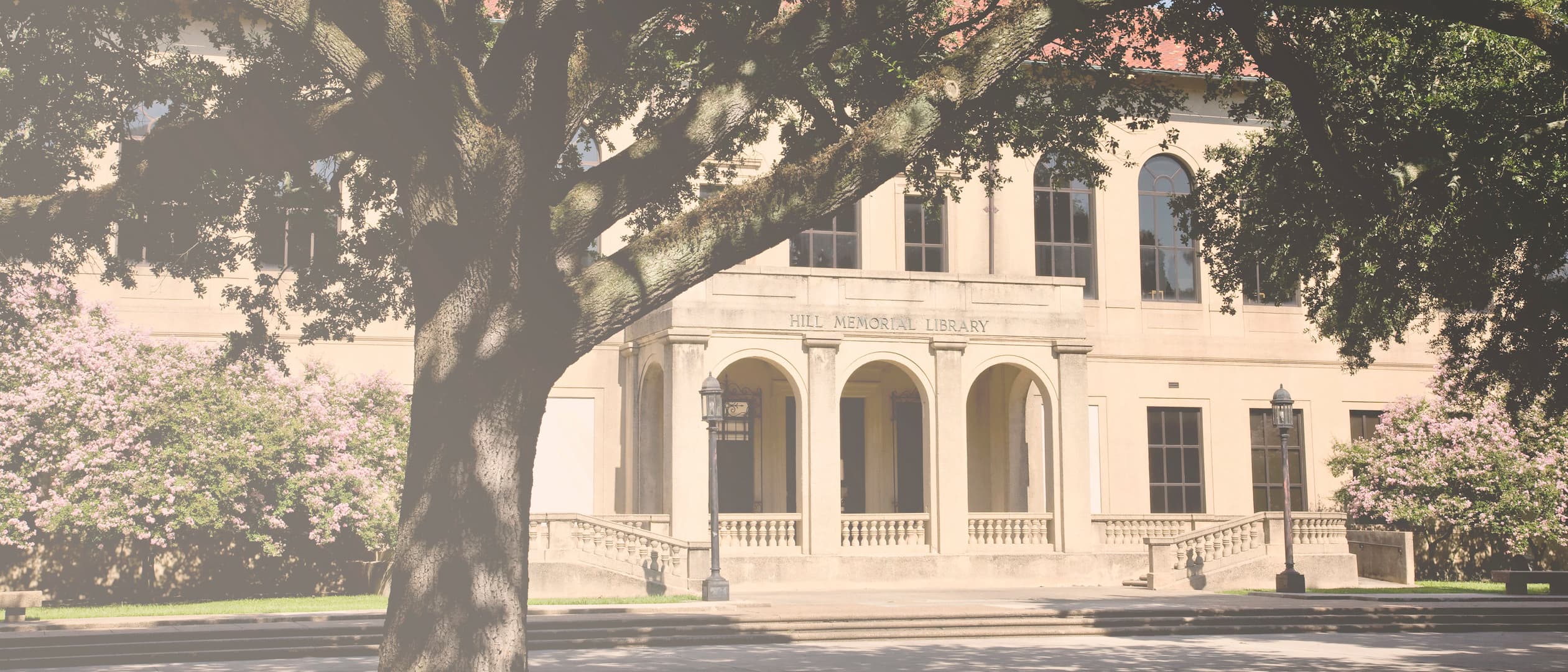
Hill Memorial Library
See full hours
Acclimation of Ribulose Bisphosphate Carboxylase and mRNAs to Changing Irradiance in Adult Tobacco Leaves: Differential Expression in LSU and SSU mRNA
The transfer of Nicotiana tabacum plants grown in low light (60 micromoles quanta per square meter per second) to higher light (360 micromoles quanta per square meter per second) was previously shown to induce adaptive stimulation of photosynthetic capacities. The variations of ribulose bisphosphate carboxylase/oxygenase (RubisCo) expression in mature leaves was examined as a result of this acclimation. Maximum or initial activities increased markedly after low- to high-light transfer with a maximum effect after 2 to 3 days. The higher activity is mainly explained by RubisCo protein synthesis as shown by immuno-rocket technique. Small subunits of RubisCo (SSU) mRNA relative content determined by hybridization of total RNA with DNA probe by Dot-blot method, followed the same pattern as RubisCo quantity. The magnitude of this response was amplified when more contrasting light conditions (25 versus 360 micromoles per square meter per second) were established on the same leaf: RubisCo activity, RubisCo protein, and SSU mRNA contents decreased in the shaded zone and increased in the high-light zone within 1 day. After 2 days the shade/light ratio was 1 to 3 for RubisCo protein and 1 to 4 for SSU-RNA, whereas the ratios remained equal to one in controls. Hybridization of the same RNA extracts with large subunits of RubisCo (LSU) probe showed no variation in LSU-RNA content. So in green adult leaves, the expression of SSU and LSU genes is regulated differently. The observed white light quantitative effect on RubisCo expression was not dependent on the photosynthetic rate or assimilate content since low CO 2 concentration around the leaf after the light shift did not modify the response.
Biodiversity and spatial distribution of potentially ciguatera-causing dinoflagellates using DNA metabarcoding
Ciguatera poisoning (CP) is a foodborne disease caused by eating seafood containing ciguatoxins from benthic dinoflagellates of the genus Gambierdiscus. Moreover, the related Fukuyoa, which often coexists with Gambierdiscus, also produces potent marine toxins. Though CP is endemic to tropical regions, it is increasingly being reported elsewhere, including the Canary Islands (NE Atlantic). In the Balearic Islands (W Mediterranean), potentially ciguatoxin-producing species have been found frequently in recent years, but so far without documented CP. Since toxin production varies greatly among Gambierdiscus and Fukuyoa species, it is very important to be able to discriminate them and detect problematic species even when present in low densities. In this study we explored the potential of DNA metabarcoding targeting the D1-D2 LSU rDNA region to detect Gambierdiscus and Fukuyoa species alongside other dinoflagellates and microeukaryotes in the first such surveys of the studied archipelagos. The predominant species by far in the Balearics was G. australes, but in Gran Canaria, though abundant, it was often outnumbered by two more toxic species, G. excentricus and G. silvae. DNA metabarcoding recorded F. ruetzleri for the first time in the Canaries and G. carolinianus in the Balearics, both in very low relative abundance. A potential new species of Gambierdiscus (“occultus”) was detected in three Balearic Islands and Gran Canaria. Extensive intragenomic variation in the D1-D2 marker was found. We could also characterize the broader dinoflagellate community, including other harmful species and also parasitoids that may affect the dynamics of the dinoflagellates present. This research shows the power of LSU rDNA-based metabarcoding for studying benthic microeukaryotic communities.

Archive Records

1788
Processed vs unprocessed collection--what's the difference?
A processed collection has gone through several steps to become a cataloged record, thus available to the researching public. Those steps include a thorough vetting of copyright and restrictions, a verbatim transcription or thorough indexing of the interview including time-stamped calibration, the opportunity for the interviewee to review the transcription, the creation of a finding aid that includes important metadata about the collection, the preservation and optimization of audio files, the creation of user-copies, and cataloging. This process requires the efforts of several LSU Libraries staff members and it has been calculated that for every hour of recording, it takes 35-50 hours to fully process. For a detailed breakdown of the stages and fees associated with archiving oral histories, please see The Oral History Budget. All processed collections are found in the catalog record and many are available on the Louisiana Digital Library. An unprocessed collection is one that has not reached the final stage of completion and is not yet ready to be cataloged. Depending on the stage of processing, more or less of the interview will be available to patrons. See below for the availability of unprocessed collections. An unprocessed collection is not in the catalog record nor the Louisiana Digital Library. A processed collection has gone through several steps to become a cataloged record, thus available to the researching public. Those steps include a thorough vetting of copyright and restrictions, a verbatim transcription or thorough indexing of the interview including time-stamped calibration, the opportunity for the interviewee to review the transcription, the creation of a finding aid that includes important metadata about the collection, the preservation and optimization of audio files, the creation of user-copies, and cataloging. This process requires the efforts of several LSU Libraries staff members and it has been calculated that for every hour of recording, it takes 35-50 hours to fully process. For a detailed breakdown of the stages and fees associated with archiving oral histories, please see The Oral History Budget. All processed collections are found in the catalog record and many are available on the Louisiana Digital Library. An unprocessed collection is one that has not reached the final stage of completion and is not yet ready to be cataloged. Depending on the stage of processing, more or less of the interview will be available to patrons. See below for the availability of unprocessed collections. An unprocessed collection is not in the catalog record nor the Louisiana Digital Library. Answered by: Jennifer Cramer
What are Special Collections?
Special collections refer to unique materials that provide both primary and secondary sources to people conducting original research. Our collections are special due to their scarcity or rarity, historical value, monetary value, or research value. Archives are collections of original records created throughout the lifespan of a person, family, organization, or business. These materials essentially provide evidence of the activities, events, functions, and/or responsibilities of the creator(s). Archives and special collections differ from libraries in the types of materials collected and the ways in which they are acquired, organized, described, and made publicly accessible. These differences prompt us to create specific policies and procedures to ensure that our collections can continue to be used for decades or even centuries to come. Special collections refer to unique materials that provide both primary and secondary sources to people conducting original research. Our collections are special due to their scarcity or rarity, historical value, monetary value, or research value. Archives are collections of original records created throughout the lifespan of a person, family, organization, or business. These materials essentially provide evidence of the activities, events, functions, and/or responsibilities of the creator(s). Archives and special collections differ from libraries in the types of materials collected and the ways in which they are acquired, organized, described, and made publicly accessible. These differences prompt us to create specific policies and procedures to ensure that our collections can continue to be used for decades or even centuries to come. Answered by: Kelly Larson

Gear

44

Staff

101
Ask Us
AskUs Homepage
Hidden Tiles
expand
Tile Cover
laptop and books
Accounts listing
expand
Tile Cover
People troubleshooting on a computer
Ask Us
Service
Tile Short Summary
Check our FAQs, submit a question using our form, or launch the chat widget to find help.