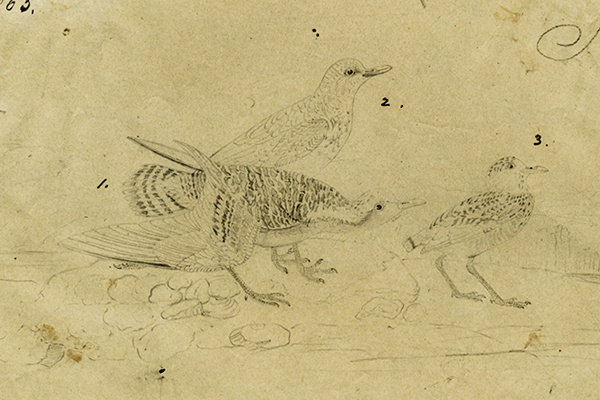
Black-bellied Plover
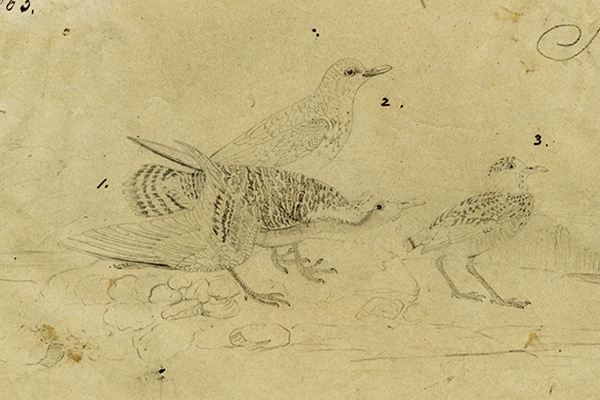
Charadrius helveticus, Linn. [now Pluvialis squatarola]
Octavo edition, plate 63
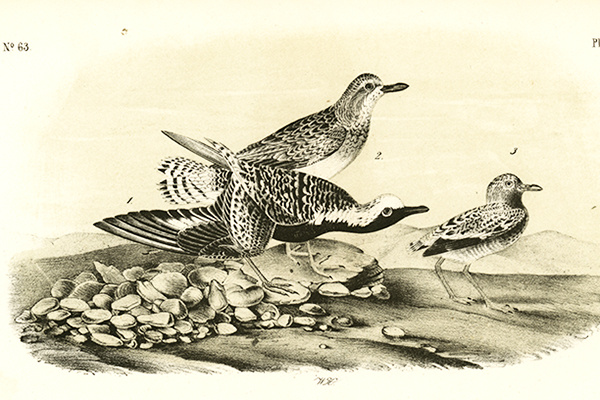
Charadrius helveticus, Linn. [now Pluvialis squatarola]
Octavo edition, plate 63
“This beautiful bird makes its appearance on our southern coasts in the beginning of April, as I had many opportunities of observing in the course of my journey along the shores of the Gulf of Mexico, in the spring of 1837. Instead of being congregated in large flocks, as is the case during their southward migration in autumn, they are seen coming in small numbers, but at short intervals, so as almost to form a continuous line. They travel chiefly by night, and rest for a great part of the day along the margins of the sea, either reposing on the sands in the sunshine, or searching the beaches for food. After dusk their well-known cries give note of their passage, but by day they remain silent, even when forced to betake themselves to flight . . . This species is known in Pennsylvania by the name of Whistling Field Plover, suggested by the loud and modulated cries which it emits during the love-season.â€ÂÂÂÂ
John James Audubon, Birds of America (New York: J.J. Audubon; Philadelphia: J. B. Chevalier, 1840-1844), vol. 5, p. 199-200.
View bird in National Audubon Society Guide to North American Birds.