From the Stacks: Golden G. Richard, III
LSU Libraries celebrates the research and creativity of LSU faculty through "From the Stacks: LSU Faculty Authors," a monthly Q&A series highlighting recent books written by LSU faculty members. This initiative highlights recent publications, offering insight into the scholarship that shapes the university’s academic community. All faculty-authored books are included in the Libraries’ physical collection and as part of the faculty book list in the LSU Scholarly Repository.
Golden G. Richard, III
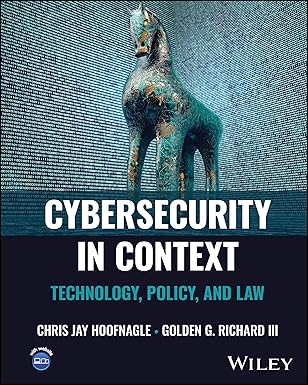
Golden G. Richard, III is a professor of Computer Science and Engineering, director of the LSU Cyber Center and the Applied Cybersecurity Lab (ACL), and associate director for cybersecurity at the Center for Computation and Technology (CCT), all at LSU, as well as a fellow of the American Academy of Forensic Sciences. Below, he discusses Cybersecurity in Context: Technology, Policy, and Law which he co-authored with Chris Jay Hoofnagle. This book is a cutting-edge guide to all key aspects of one of this century's most important fields.
Tell us about your field of study, your education, and work history.
I'm a self-taught programmer. I began writing software at age thirteen, right at the dawn of affordable microcomputers. There was a Radio Shack near my house, and I spent every waking hour there for years, until I could afford my own computer.
I attended the University of New Orleans (UNO) and received a B.S. in computer science with a minor in philosophy. My undergraduate work there was hard, inspirational, and incredibly valuable. At the time, UNO was primarily an undergraduate teaching institution, and I had stellar undergraduate educational experience. I then went to Ohio State for an M.S. and Ph.D. in computer science. I then returned to UNO, taught and did research there for 20 years, then was recruited by LSU to build their cybersecurity program.
Does writing come easily to you, or is it a struggle?
Programming comes easily to me. Writing, less so.
What drew you to the specific subject of your book, cybersecurity? Why was it important to write it?
While I have broad experience in computer science, I've focused on cybersecurity since about 2000. [My co-author, Chris Jay Hoofnagle] and I think this book is an important one because a lot of cybersecurity books are incredibly technical and inaccessible to non-experts. That's great for a select audience, but we wanted to create a book that anyone can read and one which looks at cybersecurity with a broader focus—on technical issues, policy, law, and politics.
Writing is part inspirational and part mechanical. Do you have a writing routine?
My writing routine probably mirrors that of many others: start to write, procrastinate, stare, work on programming projects instead of writing, and finally feel some inner pressure building. Then, sit and just do it.
Are you envisioning a follow-up?
Yes. Because cybersecurity is so fast moving, we are planning a second edition within the next year or so.
What works do you consider essential for anyone in your field?
It depends to some degree on your focus, but for people developing cybersecurity tools, performance is incredibly important. The books that R. Richard Stevens wrote on systems programming, e.g., Advanced Programming in the Unix Environment, are not specifically about cybersecurity, but will radically improve programming skills. In cybersecurity, look for Bruce Schneier’s and Ross Anderson's books and then go from there.
Do you have any advice for students and other researchers in your field who may want to write a book?
This sounds obvious, but write only if you're passionate about the subject and see a clear gap in what's already available that you're quite sure you can fill. It's time consuming and absolutely not going to make you rich.
What else should we know about you?
I'm a retired skateboarder. I miss it, but I've returned to biking as a substitute. I'm an avid reader, and I collect books, and they are piled everywhere. I never doom scroll videos. And, I'm a passionate cook. No offense, but my étouffée is better than yours!
LSU Libraries supports faculty authors by collecting and preserving their work in the LSU Scholarly Repository and by helping make LSU research more widely discoverable through open-access initiatives.