Inside the 2025–2026 Special Collections Faculty Fellowship
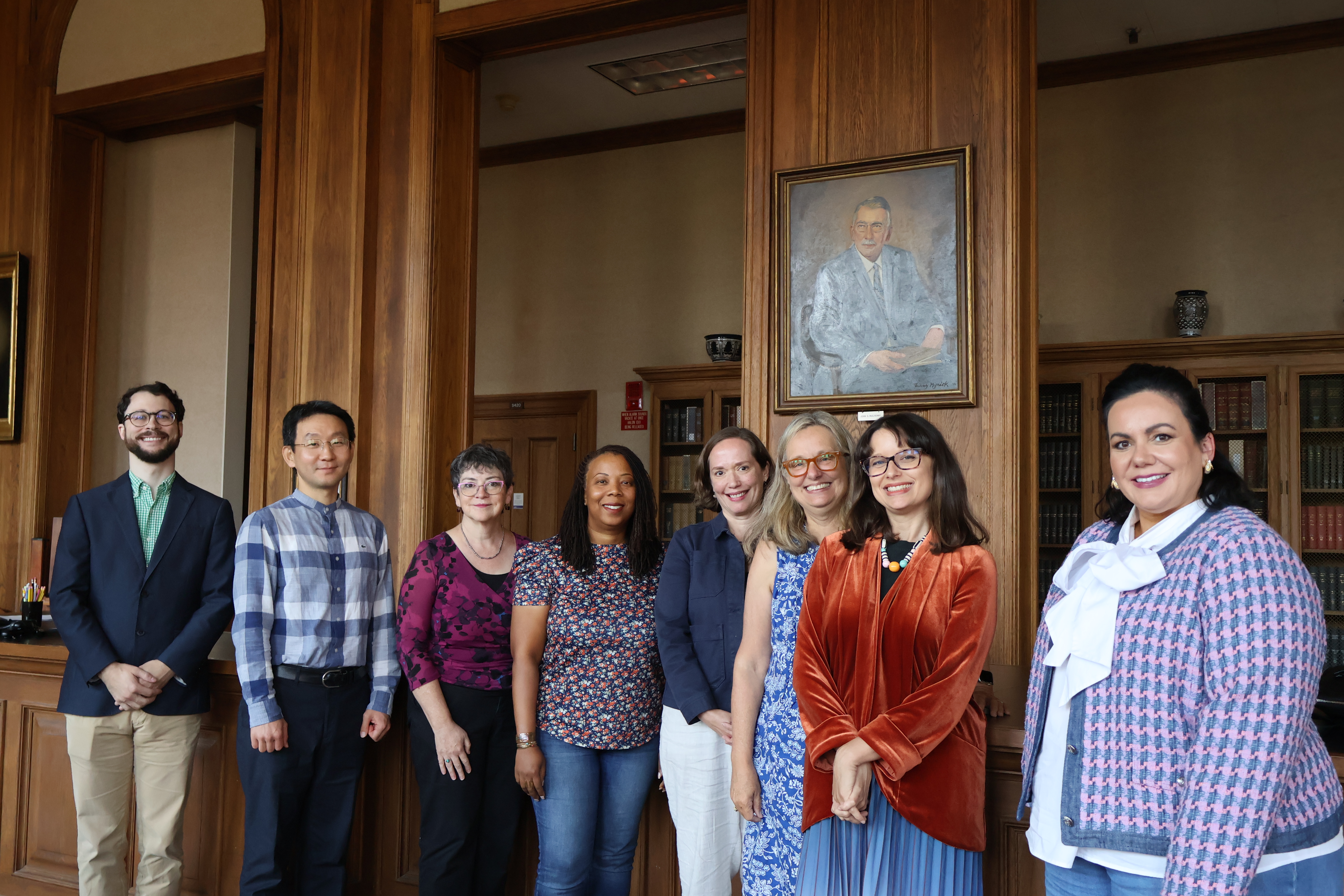
In its third year, the LSU Libraries Special Collections Faculty Fellowship had its largest cohort, with eight faculty members joining the program. These faculty members from a variety of departments worked closely with Special Collections staff to gain a better understanding of the collections themselves as well as how to integrate archival materials into their courses. The 2025-2026 cohort included Nolde Alexius, Joy Blanchard, Maribel Dietz, Sherri Johnson, Todd Johnson, Nolonda Jones, Yong-Ha Kim, and Jessica Valdez. Throughout the fall semester, the program was led by Brandon Layton, Special Collections’ Digital Engagement and Pedagogy Librarian.
Nolde Alexius, a Distinguished Instructor in the English department, has worked at LSU for 25 years and utilized the Faculty Fellowship to further develop her English 2025 class. She believes Special Collections “shows the influence of time and place, of literary communities, and of evolving media platforms on LSU fiction writers.” She was drawn to the program to design a project that develops students' literary preferences, critical thinking skills, and archival research experience through direct engagement with authors’ materials.
Joy Blanchard is an associate professor in the Lutrill & Pearl Payne School of Education and has been at LSU since 2015. She plans to utilize the collections in her “Foundations of Higher Education” course, which explores the history of American higher education. The materials will help bridge course texts with the history of LSU's campus, particularly the student experience, while addressing topics such as the history of American higher education from the colonial period to the present, changing curriculums, widening access, financial constraints, and the impact university innovation has had in shaping our nation.
Maribel Dietz, an associate professor in the history department, has been at LSU for 29 years. She has long wanted to participate in the fellowship and plans to use it to develop a new upper-division undergraduate course on the premodern history of knowledge transmission. The course will explore the relationship between historical sources as students encounter them in translation and the ways those materials were originally created, copied, and transmitted.
Sherri Johnson, an associate professor in the history department, has worked at LSU for 11 years. She teaches an honors course on “Medieval Martyrs, Mystics and Monastics” and plans to use facsimiles of medieval manuscripts and some early printed books to illustrate the “pursuit of holiness in medieval Europe.” As students learn about individuals and sources, they will plan a research project related to one of the themes. Johnson aims to integrate visual materials in the class to a greater extent.
Todd Johnson, an assistant professor of forest entomology, began working at LSU in 2022. He encourages students to identify patterns in nature and understand how context shapes environmental outcomes. Through the fellowship, he is developing a syllabus and activities for a new course (ENTM 4018) that will incorporate historical theses and dissertations from LSU. This approach will help students understand how knowledge about forest ecosystems has been generated and applied over time.
Nolonda Jones is in her fourth year as an assistant professor in the LSU College of Art + Design. In the class she is developing, students will learn about historic preservation by using the Special Collections materials and digital humanities tools to create a collaborative digital repository documenting about 57 places on LSU’s campus that are on the National Register of Historic Places.
Yong-Ha Kim, an associate professor in environmental sciences, plans to use Special Collections to examine historical environmental challenges in Louisiana, including sea-level rise, wetland loss, and Hurricane Katrina. In his course, “ENVS 3102 Mathematical Methods in Science,” students will collect and analyze archival records and data using quantitative methods. The project will also contribute to developing digital archives and training approaches for environmental science students.
Jessica Valdez is an assistant professor of nineteenth-century British literature and culture. She will use Special Collections in her undergraduate course on “Victorian True Crime” and to develop a new graduate course, “Victorian Multimedia.” Her goal is to broaden students’ understanding of nineteenth-century media and culture while helping them analyze their own. According to Valdez, “Students tend to imagine that people in the nineteenth century had nothing to do—that they were so bored sitting at home that they ended up reading books. I want them to have a fuller appreciation of the kinds of media, culture, and texts that people consumed in the nineteenth century.” The course will train students to work with a range of archival materials and examine historical communication systems.