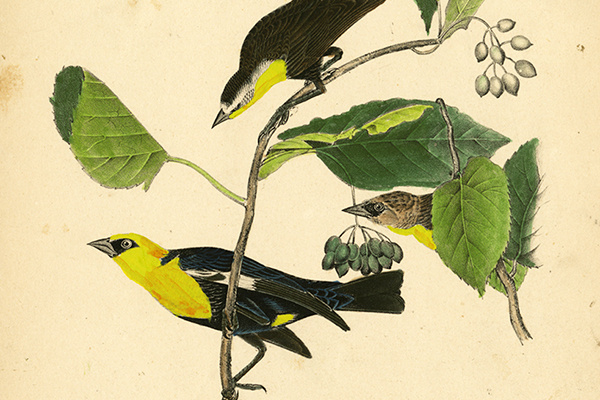
Saffron-headed Marsh Black-bird
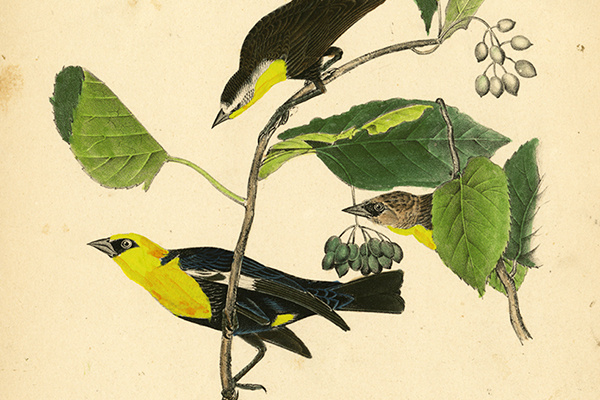
Xanthocephalus xanthocephalus
Octavo edition, plate 213
“This species was first made known as an inhabitant of North America by the naturalists of Major Long's expedition to the Rocky Mountains. According to Dr. Richardson, ‘the species ranges in summer to about the fifty-eighth parallel,’ but has not been found to the eastward of the Mississippi, where it arrives from the southward in the middle of May, and by the 20th of the same month reaches the Saskatchewan, where it associates with the Redwing, and, being more numerous, commits even greater havoc in the corn-fields. Mr. Nuttall has favoured me with the following notice respecting it. 'On the 2d of May, around the Kansa (Texian) Agency, we now saw abundance of the Yellow-headed Troopial, associated with the Cow-bird . . . in the manner of the Cow-bird, whistle out with great effort, a chuckling note sounding like ko-kukkle-ait , often varying into a straining squeak, as if using their utmost endeavour to make some kind of noise in token of sociability.’ . . . â€œI have represented a male, a female, and the head of a young bird approaching towards maturity.â€ÂÂÂÂ
John James Audubon, Birds of America (New York: J.J. Audubon; Philadelphia: J. B. Chevalier, 1840-1844), vol. 4, p. 24.
View bird in National Audubon Society Guide to North American Birds.