Bento Search Concept Page

Sections
HTML elements

Bento Search

Search all of LSU Libraries in one place. This includes the catalog, research guides, scholarly repository, website, etc.

What does bento search?

Bento searches all of the available resources at LSU Libraries. Please note that while Discovery does include Catalog results, the dedicated Catalog search can still be accessed.

Discovery
Searches our local print and electronic materials including e-books, journal articles, peer-reviewed articles, news, and magazines.
Research Guides
Searches the full-text of research guides published by LSU Libraries. A research guide is a curated, librarian‑built document that pulls together the most important resources for a topic, course, or assignment. It’s designed to help students, faculty, and researchers quickly find high‑quality, relevant information without having to sift through everything on their own.
Scholarly Repository
Searches the full-text of the Scholarly Repository. The LSU Scholarly Repository collects, preserves, publishes, and makes openly accessible the research and scholarship contributed by LSU faculty, staff, students, and units. Research and scholarly archived materials can include articles, monographs, books, theses & dissertations, audio-visual presentations, working papers, technical reports, conference proceedings, special collections, data, and publicly funded research.
Hours
Main Library
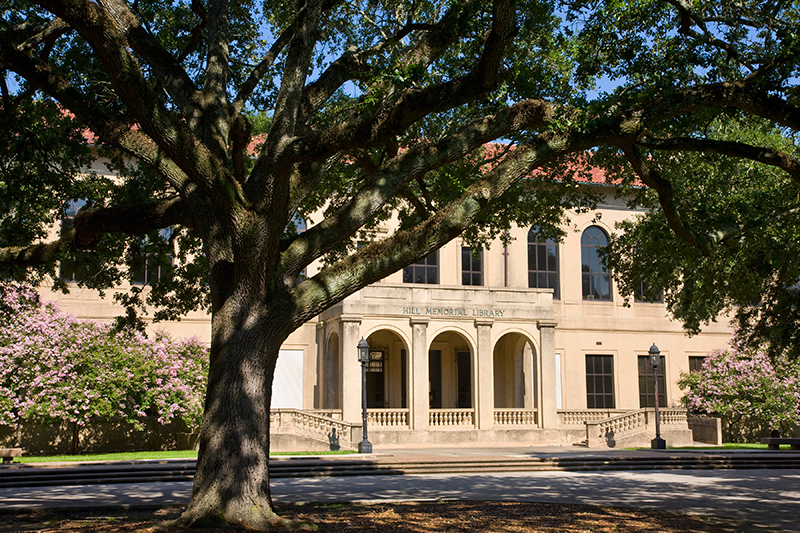
Hill Memorial Library
See full hours
Utility of nuclear SSU and LSU rDNA data sets to discover the ordinal placement of the Coccotremataceae (Ascomycota)
Abstract Informal ascomycete classifications have traditionally been based in part on ascomatal morphologies. The problems associated with grouping taxa using ascomatal characters are evidenced in the Coccotremataceae where the ascomata have been interpreted either as apothecia or perithecia. We used SSU rDNA sequences representing all classes of the Pezizomycotina to infer the phylogenetic position of the family. The Coccotremataceae clustered within the Lecanoromycetes. Since the Lecanoromycetes are characterized by the presence of apothecia, these data support the apothecial interpretation, given that the ascomata of the Coccotremataceae are not the result of convergent evolution. To evaluate the ordinal placement of the Coccotremataceae we used sequences of the SSU rRNA and LSU rRNA gene of 12 Lecanoromycetes. The SSU and LSU portions of this second analysis reveal conflicting phylogenies. Therefore we compared the two portions with additional statistical tests: splits decomposition, an analysis of the distribution of homoplasy, and a calculation of the ideal nucleotide substitution rate. In all of these tests the LSU data performed better than the SSU data. The results of the incongruence length difference (ILD) test suggest the data portions could be combined. There is no difference in the tree topology of the combined data set and of the LSU portion only, but the bootstrap values in the combined tree are lower. We argue that the low bootstrap supports in the combined tree are due to the phylogenetic signal in the SSU data set. Therefore we use the LSU and the combined tree to base our classification of the Coccotremataceae. In the LSU and the combined tree the inclusion of the Coccotremataceae in the Pertusariales is supported as is the sister relationship of the Pertusariales and Agyriales. Within the Pertusariales the Coccotremataceae and Pertusariaceae are well-supported sister taxa.
Phylogeny and species delineation in the marine diatom Pseudo‐nitzschia (Bacillariophyta) using cox1, LSU, and ITS2 rRNA genes: A perspective in character evolution.
Analyses of the mitochondrial cox1, the nuclear‐encoded large subunit (LSU), and the internal transcribed spacer 2 (ITS2) RNA coding region of Pseudo‐nitzschia revealed that the P. pseudodelicatissima complex can be phylogenetically grouped into three distinct clades (Groups I–III), while the P. delicatissima complex forms another distinct clade (Group IV) in both the LSU and ITS2 phylogenetic trees. It was elucidated that comprehensive taxon sampling (sampling of sequences), selection of appropriate target genes and outgroup, and alignment strategies influenced the phylogenetic accuracy. Based on the genetic divergence, ITS2 resulted in the most resolved trees, followed by cox1 and LSU. The morphological characters available for Pseudo‐nitzschia, although limited in number, were overall in agreement with the phylogenies when mapped onto the ITS2 tree. Information on the presence/absence of a central nodule, number of rows of poroids in each stria, and of sectors dividing the poroids mapped onto the ITS2 tree revealed the evolution of the recently diverged species. The morphologically based species complexes showed evolutionary relevance in agreement with molecular phylogeny inferred from ITS2 sequence–structure data. The data set of the hypervariable region of ITS2 improved the phylogenetic inference compared to the cox1 and LSU data sets. The taxonomic status of P. cuspidata and P. pseudodelicatissima requires further elucidation. [ABSTRACT FROM AUTHOR]
Islandinium minutum subsp. barbatum subsp. nov. (Dinoflagellata), a New Organic‐Walled Dinoflagellate Cyst from the Western Arctic: Morphology, Phylogenetic Position Based on SSU rDNA and LSU rDNA, and Distribution
A study of modern sediment from the Western Arctic has revealed the presence of a distinctive brown‐colored cyst with a spherical central body bearing unbranched processes that are usually solid with a small basal pericoel. Distinctive barbs project from some processes, and process tips are usually minutely expanded into conjoined barbs. The archeopyle is apical and saphopylic. This cyst corresponds to Islandinium? cezare morphotype 2 of Head et al. (2001, J. Quat. Sci., 16:621). Phylogenetic analyses based on the small and large subunit rRNA genes infer close relationship with Islandinium minutum, the type of which is that of the genus. Re‐examination of specimens of I. minutum reveals the presence of minute barbs on its processes, but differences with Islandinium? cezare morphotype 2 remain based on size, process distribution, and barb development. Furthermore, the internal transcribed spacer shows I. minutum to be distinct from this morphotype. On the basis of these small but discrete differences, we propose the new subspecies Islandinium minutum subsp. barbatum subsp. nov. Molecular sequencing of other cysts encountered, namely Echinidinium karaense, an unidentified flattened cyst, and “Polykrikos quadratus”, places them in the Monovela clade, the latter showing greater morphological variability than previously thought.

Archive Records

1788

Website

209

Gear

44

Staff

101
Ask Us
AskUs Homepage
Hidden Tiles
expand
Tile Cover
laptop and books
Accounts listing
expand
Tile Cover
People troubleshooting on a computer
Ask Us
Service
Tile Short Summary
Check our FAQs, submit a question using our form, or launch the chat widget to find help.