Bento Search Concept Page

Sections
HTML elements

Bento Search

Search all of LSU Libraries in one place. This includes the catalog, research guides, scholarly repository, website, etc.

What does bento search?

Bento searches all of the available resources at LSU Libraries. Please note that while Discovery does include Catalog results, the dedicated Catalog search can still be accessed.

Discovery
Searches our local print and electronic materials including e-books, journal articles, peer-reviewed articles, news, and magazines.
Research Guides
Searches the full-text of research guides published by LSU Libraries. A research guide is a curated, librarian‑built document that pulls together the most important resources for a topic, course, or assignment. It’s designed to help students, faculty, and researchers quickly find high‑quality, relevant information without having to sift through everything on their own.
Scholarly Repository
Searches the full-text of the Scholarly Repository. The LSU Scholarly Repository collects, preserves, publishes, and makes openly accessible the research and scholarship contributed by LSU faculty, staff, students, and units. Research and scholarly archived materials can include articles, monographs, books, theses & dissertations, audio-visual presentations, working papers, technical reports, conference proceedings, special collections, data, and publicly funded research.
Hours
Main Library
Hill Memorial Library
See full hours
Phylogenetic analysis of LSU and SSU r DNA group I introns of lichen photobionts associated with the genera Xanthoria and Xanthomendoza ( Teloschistaceae, lichenized Ascomycetes).
We studied group I introns in sterile cultures of selected groups of lichen photobionts, focusing on Trebouxia species associated with Xanthoria s. lat. (including Xanthomendoza spp.; lichen-forming ascomycetes). Group I introns were found inserted after position 798 ( Escherichia coli numbering) in the large subunit ( LSU) r RNA in representatives of the green algal genera Trebouxia and Asterochloris. The 798 intron was found in about 25% of Xanthoria photobionts including several reference strains obtained from algal culture collections. An alignment of LSU-encoded r DNA intron sequences revealed high similarity of these sequences allowing their phylogenetic analysis. The 798 group I intron phylogeny was largely congruent with a phylogeny of the internal transcribed spacer region, indicating that the insertion of the intron most likely occurred in the common ancestor of the genera Trebouxia and Asterochloris. The intron was vertically inherited in some taxa, but lost in others. The high-sequence similarity of this intron to one found in Chlorella angustoellipsoidea suggests that the 798 intron was either present in the common ancestor of Trebouxiophyceae, or that its present distribution results from more recent horizontal transfers, followed by vertical inheritance and loss. Analysis of another group I intron shared by these photobionts at small subunit position 1512 supports the hypothesis of repeated lateral transfers of this intron among some taxa, but loss among others. Our data confirm that the history of group I introns is characterized by repeated horizontal transfers, and suggests that some of these introns have ancient origins within Chlorophyta. [ABSTRACT FROM AUTHOR]
Alteration Zones Detection Using Image-Based and Spectrum-Based Image Processing Techniques to Aster Data: Sonajil Copper Deposit
The Sonajil region, renowned as a part the global copper belt, is situated within Eastern Azerbaijan province of Iran. Encircling the Sonajil copper belt are distinct halos, including potassic, phyllic, argillic, and propylitic alterations. This research employs remote sensing techniques to investigate the potential presence of porphyry mineralization in this area. Initially, the required pre-processing, including geometric and radiometric corrections, was performed on the Sonajil ASTER image. Following that, a range of alteration detection techniques was applied to the ASTER data, encompassing image-based methods such as band ratioing, as well as spectrum-based approaches including Spectral Angle Mapper (SAM), Spectral Information Divergence (SID), Mixture-Tuned Matched Filtering (MTMF), Linear Spectral Unmixing (LSU), and binary coding (BE). The results of the extracted alterations from the utilized techniques are consistent and compatible with the region's rock formations, including quartz monzonite, granodiorite, and andesite. Therefore, the possible existence of a Cu-Au porphyry deposit is confirmed by remote sensing studies. For subsequent analyses, geochemical and geophysical studies are proposed for the Sonajil area to demonstrate the existence of the porphyry deposit. The research findings and the proposed approach hold promise for identifying and targeting hydrothermally altered zones in other high-potential regions worldwide, providing a valuable tool for exploration geologists in their quest to map prospective ore deposits.
PHYLOGENY OF THE EUGLENOID LORICATE GENERA TRACHELOMONAS AND STROMBOMONAS (EUGLENOPHYTA) INFERRED FROM NUCLEAR SSU AND LSU rDNA.
Previous studies using the nuclear SSU rDNA and partial LSU rDNA have demonstrated that the euglenoid loricate taxa form a monophyletic clade within the photosynthetic euglenoid lineage. It was unclear, however, whether the loricate genera Trachelomonas and Strombomonas were monophyletic. In order to determine the relationships among the loricate taxa, SSU and LSU nuclear rDNA sequences were obtained for eight Strombomonas and 25 Trachelomonas strains and combined in a multigene phylogenetic analysis. Conserved regions of the aligned data set were used to generate maximum-likelihood (ML) and Bayesian phylogenies. Both methods recovered a strongly supported monophyletic loricate clade with Strombomonas and Trachelomonas species separated into two sister clades. Taxa in the genus Strombomonas sorted into three subclades. Within the genus Trachelomonas, five strongly supported subclades were recovered in all analyses. Key morphological features could be attributed to each of the subclades, with the major separation being that all of the spine-bearing taxa were located in two sister subclades, while the more rounded, spineless taxa formed the remaining three subclades. The separation of genera and subclades was supported by 42 distinct molecular signatures (33 in Trachelomonas and nine in Strombomonas). The morphological and molecular data supported the retention of Trachelomonas and Strombomonas as separate loricate genera. [ABSTRACT FROM AUTHOR]

Archive Records

1788

Website

209

Gear

44
Slavery in America and the World: History, Culture & Law
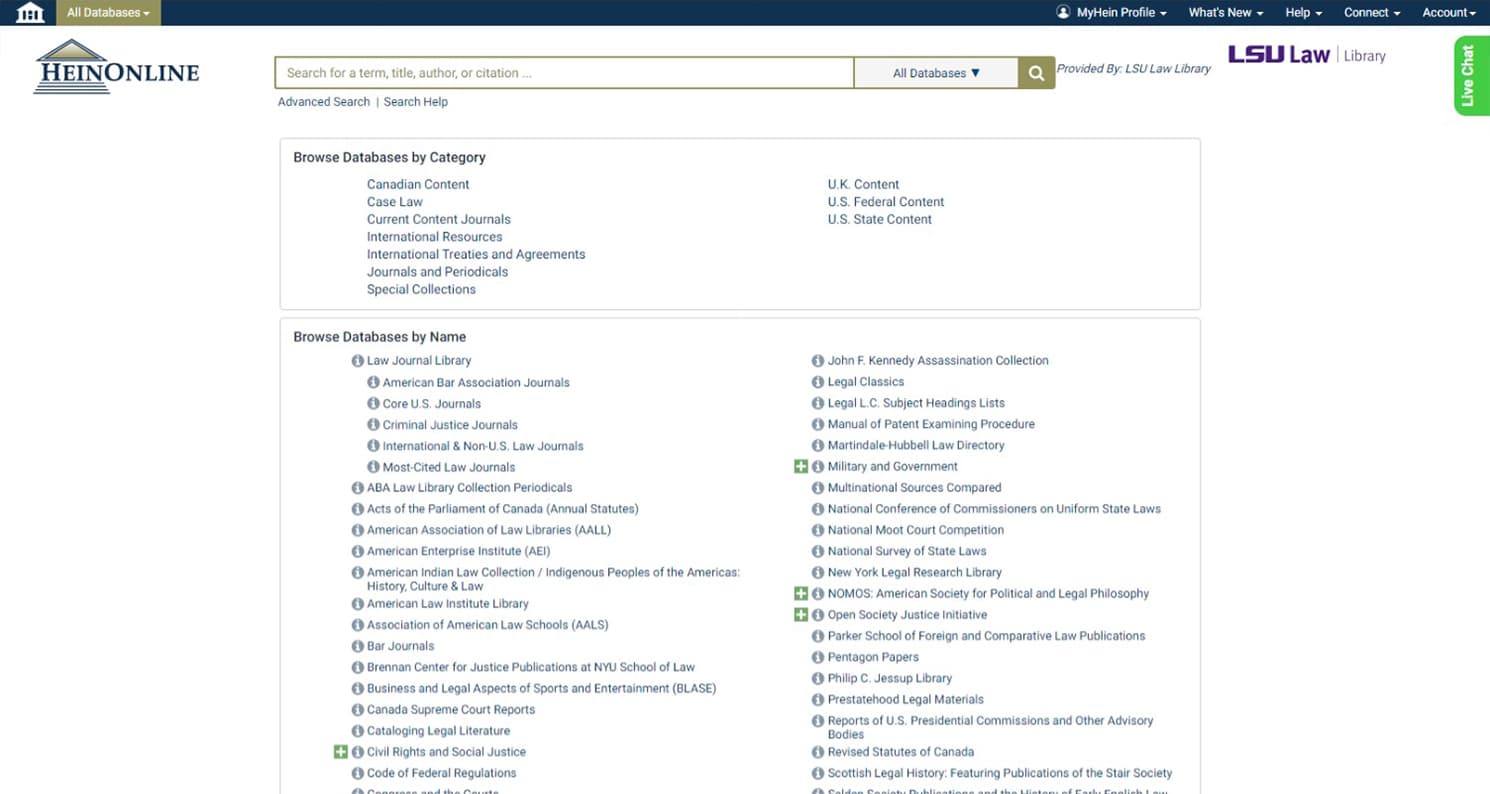
This HeinOnline collection brings together a multitude of essential legal materials on slavery in the United States and the English-speaking world. This includes every statute passed by every colony and state on slavery, every federal statute dealing with slavery, and all reported state and federal cases on slavery. Our cases go into the 20th century, because long after slavery was ended, there were still court cases based on issues emanating from slavery. To give one example, as late as 1901 Chief Justice Oliver Wendell Holmes, Jr. of the Massachusetts Supreme Judicial Court had to decide if a man, both of whose parents had been slaves, could be the legitimate heir of his father, because under southern law, slaves could never be legally married. The library has hundreds of pamphlets and books written about slaverydefending it, attacking it or simply analyzing it. We have gathered every English-language legal commentary on slavery published before 1920, which includes many essays and articles in obscure, hard-to-find journals in the United States and elsewhere. We have provided more than a thousand pamphlets and books on slavery from the 19th century. We provide word searchable access to all Congressional debates from the Continental Congress to 1880. We have also included many modern histories of slavery. Within this library is a section containing all modern law review articles on the subject. This library will continue to grow, not only from new scholarship but also from historical material that we continue to locate and add to the collection.

Staff

101
Ask Us
AskUs Homepage
Hidden Tiles
expand
Tile Cover
laptop and books
Accounts listing
expand
Tile Cover
People troubleshooting on a computer
Ask Us
Service
Tile Short Summary
Check our FAQs, submit a question using our form, or launch the chat widget to find help.