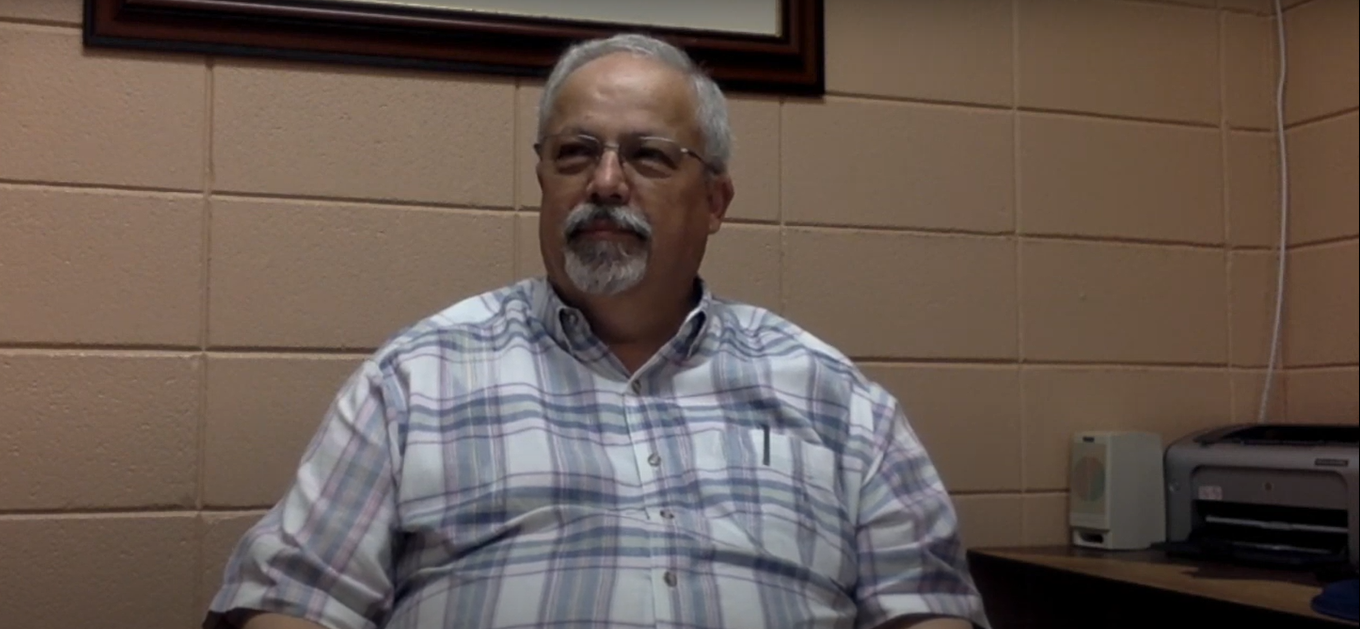
Interviewee: Barry Soileau Tape 5017 Interviewer: McKenzi Marler Session 1
Transcriber: Erin Segura Fall 2019
[Begin Tape 5017. Begin Session I.]
MCKENZI MARLER: McKenzi Marler interviewing Barry Soileau for French 2201. Quoi c’est ton nom?
BARRY SOILEAU: Mon nom, c’est Barry Soileau
MARLER: Ayoù tu viens?
SOILEAU: Je viens d’Eunice, la Louisiane, dans la Paroisse de Saint-Landry.
MARLER: Quoi c’est l’histoire que tu vas me raconter aujourd’hui?
SOILEAU: Répète ça encore?
MARLER: [laughs] Quoi c’est l’histoire que tu vas me raconter aujourd’hui?
SOILEAU: C’est une histoire d’une femme et un homme qui restaient dans la campagne et ça parlait de leur vie.
MARLER: Oui.
SOILEAU: Et … tu veux que je conte l’histoire?
MARLER: Oui.
SOILEAU: Okay. C’est l’histoire à Joséphine et Gustain. Joséphine était après laver la vaisselle un jour et elle regarde dehors et elle voit une cage à lapins et elle dit à Gustain, elle dit, “Gustain, on a une bande de lapins. Je suis tannée de manger des lapins. Tu vends pas les lapins et ça coûte un tas d’argent.” “Ouais, Marie, je connais.” “Quoi tu vas faire avec ces lapins?” “Mais,” il dit, “Je vas te dire quoi je vas faire. Je vas l’amener et je vas vendre mes lapins.” “Ça, c’est bon.” So Gustain a été et il a essayé de vendre les lapins. Il a arrivé à une place ayoù ça
[1:25] vendait des bétailles. Il dit à un de ces amis, il dit, “Quoi tu fais ici?” Il dit, “J’ai une truie à vendre.” “Une truie?” “Ouais.” Il dit, “Quoi, toi, tu fais ici?” Il dit, “Marie veut p’us manger des lapins. J’ai une bande de lapins. Il faudra je fais un trade avec les lapins.” Mais, il dit, “Quoi je vas faire avec toi?” il dit. “On va trade.” Il dit, “Moi, je vas prendre la truie,” il dit. “Toi, tu vas prendre la truie et moi je vas prendre la cage de lapins, avec les lapins.” “C’est bon.” So, Gustain s’a retourné avec Marie. Il dit à Marie, il dit, “J’ai fait un trade.” “Mais quoi t’as fait?” Il dit, “J’ai acheté une truie et je l’ai quittée dehors.” So, elle a été à la vitre. Elle a regardé. Elle dit, “Ouais, c’est une grosse truie. Tu veux la manger?” “Non, non, non,” il dit. “Je vas la mettre avec un mâle. Je vas élever des petits cochons. On va manger quoi nous-autres peut et je vas vendre les autres et je vas avoir de l’argent pour nous-autres.” “Mais,” elle dit, “ça, c’est bon.
Mais il y a une affaire qu’est mauvais.” Il dit, “Quoi c’est ça?” “T’as pas de mâle.” “Mais,” il dit, “mon grand ami a un mâle cochon.” “Ah!” “Mais,” il dit. “ça, c’est bon.” So, le lendemain matin, il a pris la truie. Il l’a mis dans la bourouette et il a parti. Il a amené la truie au mâle avec son ami. Il dit, “Quoi il faut que je fais?” “Mais, tu quittes la truie ici. Le lendemain matin je vas la ramener.” [Il l’a pris.] So il a venu. Il a mis la truie back dans la bourouette. Il l’a ramenée chez lui. Avant il a gone, il a dit à son ami, “Comment je vas connaître, la truie, si elle va avec des petits?” Il dit, “Écoute. Dans deux ou trois jours, si elle est après jouer dans la poussière, ç’a pas pris. Il faudra tu ramènes la truie encore.” “Ça c’est bon.” Deux ou trois jours ont passé. Il regarde dehors. La truie était après se baigner dans la poussière. “Well,” il dit. “il faut que je la ramène.” Puis, il a remis la truie dans la bourouette. Il l’a ramenée chez son ami. Le lendemain matin, il a retourné. Il a mis la truie dans la bourouette. Il l’a ramenée chez lui. Deux ou trois jours ont passé. Il a regardé dehors. La truie était après se baigner dans la poussière encore.
[3:31] “Mais,” il dit. “réellement!” Mais, il a pas perdu courage. Il dit, “Marie, je suis regone back.” Il a remis back la truie dans la bourouette. Il l’a ramenée chez son ami. Il dit à son ami, “Je suis rendu. Je suis dégouté.” “Non, non,” il dit. “Perds pas courage.” Il a resté quelques jours la truie. La truie a resté quelques jours et il a été après la ramener [chez son ami]. So il était après boire le café le lendemain matin. Il dit à Marie, il dit, “Moi, je peux p’us voir dehors, regarder dehors. Regarde dehors, et s’il vous plaît, dis-moi quoi la truie est après faire.” Elle dit, “Gustain, tracasse-toi pas, cher.” Elle dit, “La truie est dans la bourouette après t’espérer.”
MARLER: [laughs]
SOILEAU: Et ça, c’est l’histoire à Joséphine [Marie] et Gustain.
MARLER: En quelle année t’as été éné?
SOILEAU: Répète ça encore.
MARLER: [laughs] En quelle année t’as été éné?
SOILEAU: Quel jour je suis éné? Je suis éné dans mai, le 28 (vingt-huit) dans 1958 (dix-neuf cinquante-huit).
MARLER: Ça, c’est pas jeune.
SOILEAU: Ça, c’est quoi?
MARLER: [laughs] Not young.
SOILEAU: Non, je suis pas jeune. J’ai 61 (soixante-et-un) ans.
MARLER: [laughs] Ayoù t’as été élevé?
SOILEAU: J’ai été élevé dans [une campagne]. Ç’appelait ça Savoy.
MARLER: [whispers] T’as été jusqu’à quel livre à l’école?
SOILEAU: [5:14] J’ai été à l’école à Eunice et j’ai commencé dans Highland. Ça c’est le nom de l’école. Là, après ça, j’ai été à une autre école. Ç’appelait ça Central. Là, j’ai gradué à Eunice High School.
MARLER: Dans ta famille, ça parlait plus en français ou en anglais quand t’étais petit? SOILEAU: Quand j’étais petit, ma mère et mon père parlaient français pour pas que je comprends quoi qui était après aller. Mais, j’ai été … j’étais élevé au ras de ma grand-mère et mon grand-père. Ça, ça parlait pas en anglais, pas du tout. Ça parlait juste en français. J’ai appris à parler en français à quatre ans. Je pouvais parler avec ma grand-mère et mon grand-père. Mais, équand ma mère et mon père parlaient de quelque chose qu’ils voulaient pas je comprends, je comprendais. Et je faisais pas comme si je comprendais.
MARLER: T’es marié?
SOILEAU: Ouais, je suis marié. Ma femme, son nom, c’est Cynthia, et c’est une Matte des Opelousas.
MARLER: Ta femme parle français.
SOILEAU: Pas du tout.
MARLER: [laughs]
SOILEAU: Juste équand elle est fâchée.
CYNTHIA SOILEAU: [laughs]
MARLER: [laughs]
CYNTHIA: I understood that one.
MARLER: [laughs] T’as des enfants?
SOILEAU: J’ai trois enfants. J’ai un garçon, deux garçons et une fille.
MARLER: [6:38] Tu travailles toujours?
SOILEAU: Oui, je travaille pour l’avocat du districte. Je suis un investigateur avec lui.
MARLER: Aujourd’hui, avec qui tu parles français?
SOILEAU: J’ai un tas de mes amis qui parlent un petit peu de français, mais j’ai quelques amis qui parlent français bien et j’essaye de parler avec eux-autres aussi longtemps et aussi souvent que je peux, parce que j’aime parler français. Je peux faire quelqu’un me comprendre un tas mieux en français qu’en anglais.
MARLER: [laughs] Merci.
SOILEAU: Mais, il y a pas de quoi. Et je suis content t’as venu me rejoindre.
MARLER: Wait, so are we still going? [laughs] Oh, thank God.
[7:39]
End Tape 5017. End Session 1.] [Total session time - 7:39]
Interviewee: Barry Soileau Tape 5017 Interviewer: McKenzi Marler Session 1
Transcriber: Erin Segura Fall 2019
[Begin Tape 5017. Begin Session I.]
MCKENZI MARLER: McKenzi Marler interviewing Barry Soileau for French 2201. What is your name ?
BARRY SOILEAU: My name is Barry Soileau.
MARLER: Where are you from ?
SOILEAU: I’m from Eunice, Louisiana, in St Landry Parish.
MARLER: What story are you going to tell me today ?
SOILEAU: Say that again ?
MARLER: [laughs] [laughs] What story are you going to tell me today ?
SOILEAU: It’s a story about a woman and a man who lived in the countryside and they talked about their life.
MARLER: Yes.
SOILEAU: And… you want me to tell you the story?
MARLER: Yes.
SOILEAU: Okay. It’s the story of Joséphine and Gustain. Joséphine was doing the dishes one day and she looks outside and she sees a rabbit cage and she says to Gustain, she says, “Gustain, we have a bunch of rabbits. I’m tired of eating rabbit. You don’t sell the rabbits and they cost a lot of money.” “Yeah, Marie, I know.” “What are you going to do with these rabbits?” “Well,” he says, “I’ll to tell you what I’m going to do. I’m going to bring the cage and I’m going to sell my rabbits.” “That’s good.” So, Gustain went and he tried to sell the rabbits. He arrived at
a place where they well animals. He says to one of his friends, he says, “What are you doing here?” He says, “I have a sow to sell.” “A sow?” “Yeah.” He says, “And you, what are you doing here?” He says, “Marie doesn’t want to eat rabbits anymore. I have a bunch of rabbits. I need to make a trade with them.” But, he says, “What am I going to do with you?” he says. “We’re going to trade.” He says, “Me, I’ll take the sow,” he says. “You, you’ll take the sow and I’ll take the cage, with the rabbits.” “That’s good.” So, Gustain returned home with it to Marie. He says to Marie, he says, “I made a trade.” “Well what did you do?” He says, “I bought a sow and left it outside.” So, she went to the window. She looked. She says, “Yeah, that’s a big sow. Do you want to eat it?” “No, no, no,” he says. “I’m going to put it with a male. I’m going to raise some little pigs. We’re going to eat what we can and I’m going to sell the others and I’ll have money for us.” “Well,” she says, “that’s good.” But there is one bad thing.” He says, “What’s that?” “You don’t have a male.” “Well,” he says, “my good friend has a male pig.” “Ah!” “Well,” he says, “that’s good.” So, the next morning, he took the sow. He put it in the wheelbarrow and he left. He brought the sow to the male that his friend had. He says, “What do I have to do?” “Well, you leave the sow here. The next morning I’ll bring it back.” [He took it.] So he came back. He put the sow back in the wheelbarrow. He brought it back to his house. Before he left, he told his friend, “How will I know if the sow’s pregnant?” He says, “Listen. In two or three days, if she’s playing in the dirt, it didn’t take. You’ll have to bring the sow over again.” “That’s good.” Two or three days passed. He looks outside. The sow was bathing in the mud. “Well,” he says, “I have to bring it back.” Then, he put the sow back in the wheelbarrow. He brought it back to his friend’s house. The next morning, he returned. He put the sow in the wheelbarrow. He brought it back to his house. Two or three days passed. He looked outside. The sow was bathing in the mud again.
[3:31] “Really!” he says. But, he didn’t lose faith. He says, “Marie, I’m going back.” He put the sow back in the wheelbarrow. He brought it back to his friend’s house. He tells his friend, “I’m back. I’m fed up.” “No, no,” he says. “Don’t be discouraged.” He let the sow stay a few days.
The sow stayed a few days and he returned home after having brought it back [to his friend’s house]. So he was drinking coffee the next morning. He says to Marie, he says, “I can’t look outside anymore. Look outside, and please, tell me what the sow is doing.” She says, “Gustain, don’t worry, dear.” She says, “The sow is in the wheelbarrow waiting for you.”