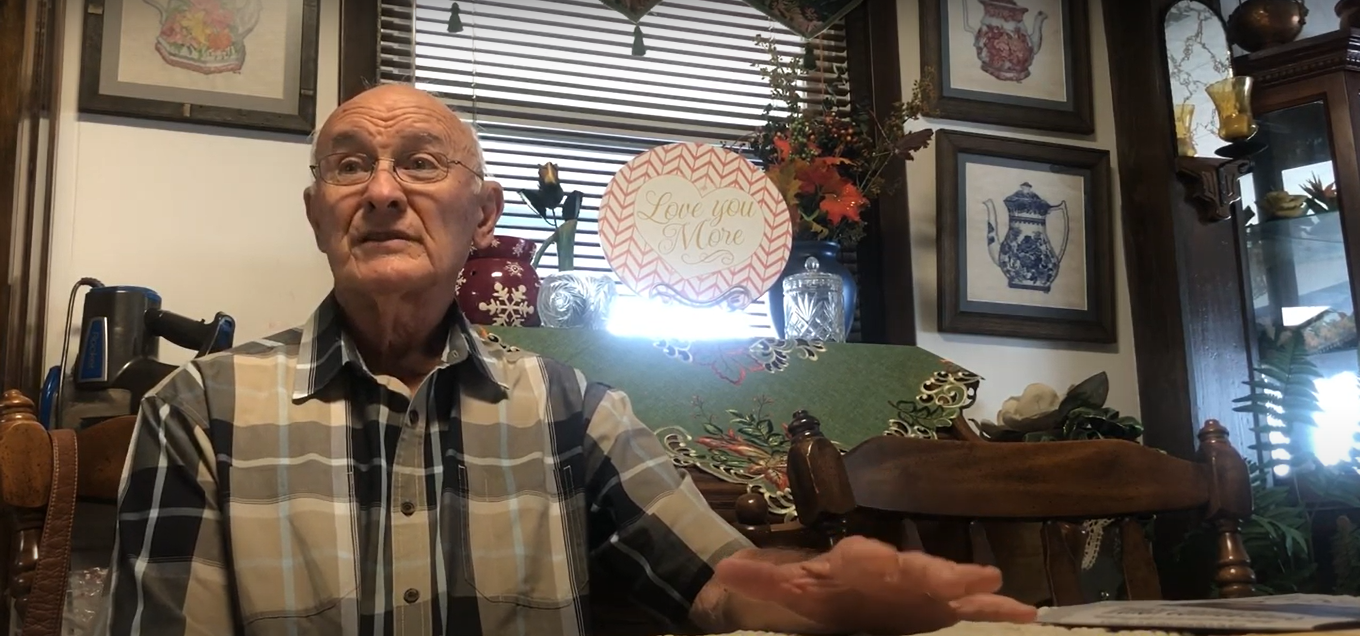
Interviewee: Nathan Woods Tape 5018 Interviewer: Lauren Garrido Session 1
Transcriber: Erin Segura October 6, 2019
Translator: Jackson Butterbaugh [Begin Tape 5018. Begin Session I.]
NATHAN WOODS: Photo?
LAUREN GARRIDO: I can.
WOODS: Okay, okay.
GARRIDO: I can edit things out -- [laughs]
WOODS: Okay.
GARRIDO: … if I need to.
WOODS: Okay.
GARRIDO: My name is Lauren Garrido and I’m here with Mr. Nathan Woods in Prairieville, Louisiana and today is October 6, 2019 and this is for a project for French 2201 at LSU. Okay. Quoi c’est ton nom ?
WOODS: Mon nom c’est Nathan Woods.
GARRIDO: Ayoù tu viens ?
WOODS: Je viens de la Paroisse Vermilion. Le village, c’est Gueydan.
GARRIDO: En quelle année t’as été éné ?
WOODS: Repeat.
GARRIDO: En quelle année t’as été éné ?
WOODS: J’ai été éné dans 1939 (dix-neuf cent trente-neuf), en décembre, le mois de décembre, le 16 (seize) de décembre.
GARRIDO: Okay. Ayoù t’as été éné ?
WOODS: [1:06] J’ai été éné dans la Paroisse Vermilion.
GARRIDO: Ayoù t’as été élevé ?
WOODS: Dans la Paroisse Vermilion, à Gueydan, Louisiane.
GARRIDO: T’as resté dans d’autres places ?
WOODS: J’ai resté dans la Paroisse Vermilion jusqu’à 1968 (dix-neuf cent soixante-huit) et là, je m’ai déménagé dans la Paroisse de Ascension.
GARRIDO: [agrees] T’as été jusqu’à quel livre à l’école ?
WOODS: Le douzième livre.
GARRIDO: [agrees] T’as étudié le français à l’école ?
WOODS: No.
GARRIDO: Dans ta famille, ça parlait plus en français ou en anglais quand t’étais petit ?
WOODS: Juste le français. GARRIDO: T’es marié ? WOODS: Mais, ouais.
GARRIDO: Ta femme parle français ?
WOODS: Un petit brin. GARRIDO: T’as des enfants ? WOODS: J’ai quatre garçons. GARRIDO: Tu travailles toujours ? WOODS: Non.
GARRIDO: Quoi c’était ton travail ?
WOODS: J’ai travaillé dans les chemical plant.
GARRIDO: [2:31] [agrees] Aujourd’hui, avec qui tu parles français ?
WOODS: Avec des amis qu’on voit à l’Association de Cadien, de musique cadienne. J’ai des amis que je rencontre. On se rencontre là et on parle français.
GARRIDO: Combien souvent tu parles français asteur ?
WOODS: Peut-être une fois par mois.
GARRIDO: [agrees] Et quoi c’est l’histoire que tu vas me raconter aujourd’hui ? WOODS: C’est une histoire que, en 1929 (dix-neuf cent vingt-neuf), c’était contre la loi de vendre de liqueur et quelque sorte de manière, il y a un char à fret qu’a été à Gueydan. J’aimerais dire de l’histoire de ça.
GARRIDO: [agrees]
WOODS: Dans 1929 (dix-neuf cent vingt-neuf), il y a un char qu’a arrivé au dépôt à Gueydan et le train master, il était pas sûr quoi c’est qu’était en dedans. Ça fait, il l’a rouvert et il a trouvé qu’il y avait de liqueur dans le char. Ça fait, il a appelé les fédérals et les fédérals ont été et ils ont décidé que, il faut … eusse voulait détruire la liqueur. La liqueur était dans des sacs, des sacs de pite avec des chaffs de riz. Ils aviont mis les bouteilles de liqueur dans les sacs. Ça fait, ils ont décidé … les fédérals disaient ils auront engager du monde qui restaient alentours pour casser … ils ont pris des haches. Ils ont cassé les sacs et cassé la liqueur pour détruire la liqueur qu’était dans les sacs. Ça fait, ils ont commencé avec des haches et eusse cassait les bouteilles pour détruire la liqueur, mais il y avait des … un tas du monde. Il y avait du monde qu’a dit, “Well, peut-être que, il y a de ces bouteilles-là qu’a pas cassé!” Ça fait, quand eusse tirait le sac à
côté pour détruire un autre sac, il y avait quelqu’un qui grab le sac et puis ça s’en allait avec.
GARRIDO: [agrees]
WOODS: [5:20] [Tu vois ?] Eusse sauvait avec la liqueur. [laughs] Ça fait, quand ç’arrivait au … il y avait juste deux hommes fédérals. Eusse pouvait pas attraper ce monde qui faisait ça. Ça fait, quand ç’arrivait autours de … quand ils étiont proche finis, il y avait du monde qui grabait ça avant quelqu’un pouvait l’écraser. [laughs]
GARRIDO: [laughs]
WOODS: Ça fait, c’est ça le conte que moi, j’ai pour 1929 (dix-neuf cent vingt-neuf).
GARRIDO: Merci.
WOODS: [laughs]
GARRIDO: Merci beaucoup.
[5:59]
[End Tape 5018. End Session 1.] [Total session time - 5:59]
Interviewee: Nathan Woods Tape 5018 Interviewer: Lauren Garrido Session 1
Transcriber: Erin Segura October 6, 2019
Translator: Jackson Butterbaugh [Begin Tape 5018. Begin Session I.]
NATHAN WOODS: Photo ?
LAUREN GARRIDO: I can.
WOODS: Okay, okay.
GARRIDO: I can edit things out -- [laughs]
WOODS: Okay.
GARRIDO: … if I need to.
WOODS: Okay.
GARRIDO: My name is Lauren Garrido and I’m here with Mr. Nathan Woods in Prairieville, Louisiana and today is October 6, 2019 and this is for a project for French 2201 at LSU. Okay. What is your name ?
WOODS: My name is Nathan Woods.
GARRIDO: Where are you from ?
WOODS: I’m from the town of Gueydan in Vermilion Parish.
GARRIDO: What year were you born ?
WOODS: Repeat ?
GARRIDO: What year were you born ? WOODS: I was born December 16th, 1939. GARRIDO: Okay. Where were you born ?
WOODS: [1:06] I was born in Vermilion Parish.
GARRIDO: Where were you raised ?
WOODS: In Gueydan, Louisiana in Vermilion Parish.
GARRIDO: Have you lived anywhere else ?
WOODS: I lived in Vermilion Parish until 1968 and then I moved to Ascension Parish.
GARRIDO: [agrees] [agrees] How many grades of school did you finish ?
WOODS: Twelfth grade.
GARRIDO: [agrees] Did you study French at school ?
WOODS: No.
GARRIDO: Did your family speak French or English more when you were little ?
WOODS: Just French. GARRIDO: Are you married ? WOODS: Well, yeah.
GARRIDO: Does your wife speak French ?
WOODS: A little bit. GARRIDO: Do you have kids ? WOODS: I have four boys.
GARRIDO: Are you still working ?
WOODS: No.
GARRIDO: What was your job ?
WOODS: I worked in the chemical plant.
GARRIDO: [agrees] These days, with whom do you speak French ?
WOODS: [2:35] With friends we see at the Cajun French Music Association. I have some friends I meet. We meet there and we speak French.
GARRIDO: How often do you speak French these days ?
WOODS: Maybe once a month.
GARRIDO: [agrees] And what story are you going to tell me today ?
WOODS: It’s a story that, in 1929, it was against the law to sell liquor and stuff like that, there’s a freight train that went to Gueydan. I’d like to tell that story.
GARRIDO: [agrees]
WOODS: In 1929, there was a train that arrived at the depot in Gueydan and the train master wasn’t sure what was in it. So, he opened it and he found out there was alcohol in the train car. So, he called the feds and the feds came and decided that they have to… they wanted to destroy the alcohol. The alcohol was in bags of peat with rice chaffs. They had put the bottles of alcohol in the bags. So, they decided… the feds said they were going to hire people who lived around there to break them… they grabbed axes. They broke the bags and the alcohol to destroy the alcohol that was in the bags. So, they started with axes and broke the bottles to get rid of the alcohol, but there were… a ton of people. There were people who said, “Well, maybe some of these bottles didn’t break!” So, when they pulled a bag to the side to destroy another bag, there was someone who would grab the bag and then they left with it.
GARRIDO: [agrees]
WOODS: [5:20] You know ? They salvaged some of the alcohol. [laughs] So, when they arrived… there were just two feds. They couldn’t catch all the people who did that. So, when
they arrived around… when they were almost done, there were people who grabbed it before someone could break it.