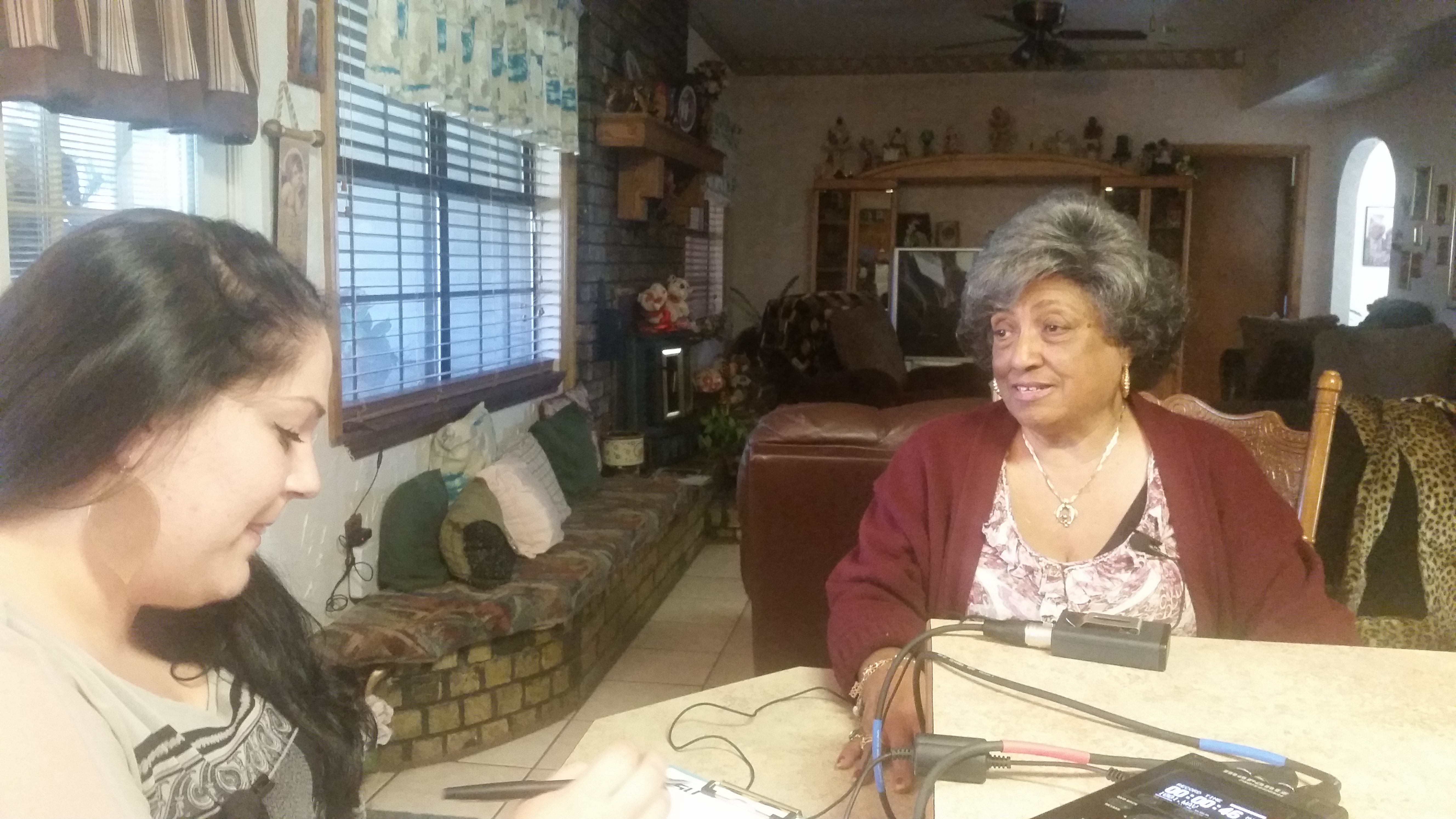
Working at the Olin plant
Audrey Sims Guillory by Rebecca Cooper, 2015.
So my very first job was cleaning house and babysitting, and I tried to keep it from her. One of my classmates got me a job taking care of this young girl that had a baby and she was working in a restaurant. The deal was she would give me two dollars a day to watch her baby and clean her house for food that she was going to give me for lunch and the two dollars. And I went there, the house was a mess. And I cleaned her house, took care of her baby, I made friends with the neighbors.
But that evening my mom found out, and she came and got me and said, "No ma'am. You will not do this. I don't care what you need, what you think you can get, I will not allow this." And she wouldn't. And I didn't do anything until I finished high school. I came to live with my father in Lake Charles and I worked at the College Inn Cafe, across the street from McNeese [State University, and I did classes at McNeese.
REBECCA COOPER: And what were you studying at McNeese?
GUILLORY: P.E. [laughs]. I wanted to be a P.E. teacher because of all of my . . . But I wind up teaching reading in the elementary school.
COOPER: At which elementary school?
GUILLORY: Eastwood Elementary.
COOPER: For how long were you in that?
GUILLORY: Seven years.
COOPER: Seven years. And then you went back to school. Is that right?
GUILLORY: I went . . . Yeah, went back to school at SOWELA [Technical Community College] in industrial technology. Worked at Olin within three months after I got that, because I wanted to make more money and I said to my husband, "Why don't you go and try to get a job across the lake at the plants?" And his answer was to me, was, "I like what I'm doing. I'm in education. You want to make more money? You quit and you go." And in three months I was there. I made more money than him. That's where we got our start. And I worked there until the Reagan administration when they [Olin] started laying everybody off.


 This project is a collaboration between the Imperial Calcasieu Museum and LSU Libraries to document the
history of Mossville, a historic African American community in Calcasieu Parish, Louisiana.
This project is a collaboration between the Imperial Calcasieu Museum and LSU Libraries to document the
history of Mossville, a historic African American community in Calcasieu Parish, Louisiana.